The Corner Pocket: How 22 Feet Is Quietly Running the NBA's Most Efficient Offense
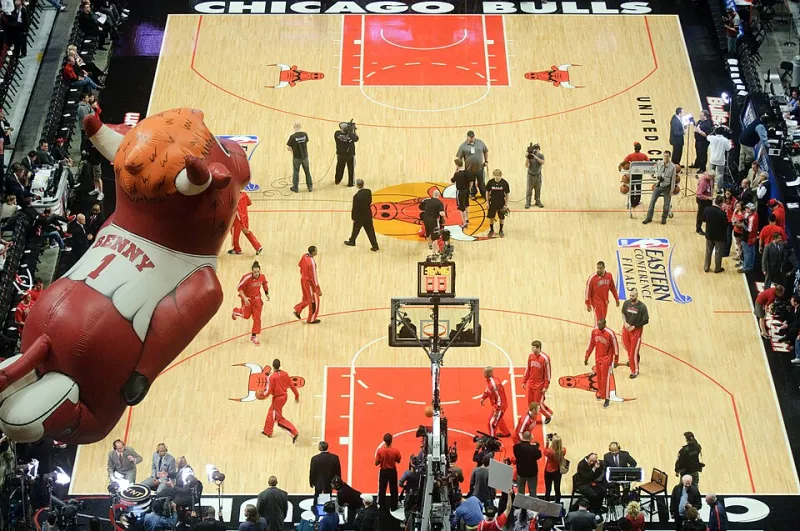
Photo: Eric Kilby, CC BY-SA 2.0, via Wikimedia Commons
There's no logo. No crowd roar when a guy drifts there. No highlight package dedicated to it. But if you've been watching the NBA closely — or more importantly, watching the numbers — you already know that the corner three has become the single most valuable piece of real estate on a basketball court.
This isn't a hot take. It's geometry.
Why 22 Feet Changes Everything
Here's the thing most casual fans don't realize: not all three-pointers are created equal. The arc in the NBA sits at 23 feet, 9 inches from the basket at its deepest point. But in the corners — those tight patches of floor between the baseline and the sideline — the distance shrinks to exactly 22 feet. That 21-inch difference might sound trivial, but for shooters, it translates to a meaningfully shorter, flatter shot with less energy required.
The data backs this up hard. League-wide, corner threes have historically converted at rates between 38% and 40%, compared to roughly 35% from above the break. When you factor in that every made three is worth the same 3 points regardless of where it's launched, the corner becomes a massive efficiency gap. We're talking about roughly 1.14 to 1.20 points per shot from the corner versus around 1.05 from the wing or top of the key. Over hundreds of possessions, that difference is a blowout waiting to happen.
The Geometry Nobody Talks About
Beyond the shorter distance, there's a second reason the corner three is such a nightmare to defend: the court itself becomes a trap.
When a shooter spots up in the corner, the baseline acts as a natural boundary. Defenders can't play behind them without conceding the shot, and they can't overplay to one side without opening a driving lane or a skip pass. The corner shooter effectively pins a defender into a binary decision — contest or concede. There's no hedge, no help-side rotation that doesn't leave someone else open.
Now layer in a ball-handler attacking the paint. The moment a big steps up to protect the rim, the weak-side corner opens up like a bay door. Teams that run their offense through the paint — think Nikola Jokic orchestrating in Denver, or Shai Gilgeous-Alexander drawing two defenders in Oklahoma City — are essentially using the corner as a pressure valve. The ball goes in, the defense collapses, the corner kicks, and it's a clean look every single time.
How the Best Teams Engineer It
This isn't accidental. The league's sharpest coaching staffs are designing entire offensive systems around corner three generation.
Boston's offense under Joe Mazzulla leans heavily on what analysts call "DHO into corner" actions — dribble handoffs that flow toward the elbow while a second shooter trails into the opposite corner. By the time the ball reversal happens, the corner man has already beaten his defender to the spot. The Celtics led the league in three-point percentage for significant stretches of the 2023-24 season, and a disproportionate chunk of those makes came from the corners.
Golden State, even in their leaner years, never abandoned the corner. Klay Thompson's off-ball movement has always been engineered to create corner looks off of Steph Curry's gravity. When Curry draws three defenders to the arc, somebody in the corner is wide open — and the Warriors have spent a decade making opposing coaches lose sleep over exactly that scenario.
On the other end of the spectrum, teams like Miami have used role players — guys who won't score 20 points a game — and turned them into legitimate weapons simply by drilling them on corner positioning and catch-and-shoot mechanics. Duncan Robinson's career is basically a case study in monetizing corner real estate.
What the Defense Has to Sacrifice
Defending the corner three forces a brutal set of tradeoffs. Zone defenses leave the corners exposed almost by design — the 2-3 zone, in particular, has a well-documented weakness in those areas. Man-to-man schemes require defenders to fight through screens and sprint across the court to close out, and a late closeout in the corner is essentially a free three.
Some teams have tried switching everything to neutralize the movement, but that creates its own problems. If you're switching a guard onto a center to prevent a corner look, you've just handed the offense a size mismatch. The geometry of the corner forces defenses into a game of whack-a-mole where solving one problem creates another.
The Undervalued Player Market
From a roster-building standpoint, the corner three has created a legitimate market inefficiency for front offices willing to do the math. A player who shoots 39% from the corner but only 31% from above the break is still producing elite value — but if teams only look at overall three-point percentage, they'll miss it.
This is where analytics-forward organizations have a real edge. Identifying players who generate high-quality corner looks, position themselves correctly off the ball, and maintain shooting mechanics under pressure is a skill that not every front office has fully developed. The ones that have — Oklahoma City, Boston, Golden State — tend to show up in the second week of May with regularity.
Point3 Takeaway
The corner three is the basketball equivalent of finding a $20 bill on the ground — it's always been there, but not everyone bends down to pick it up. The teams that have built their entire offensive identity around generating these looks aren't just playing smart basketball. They're exploiting a fundamental truth about the game's geometry that the scoreboard doesn't lie about.
Next time you're watching a game, don't just track the ball. Watch what happens in the corners. That's where the real offense lives.