Beyond the Logo: How NBA Teams Turned Half-Court Heaves Into Legitimate Offensive Strategy
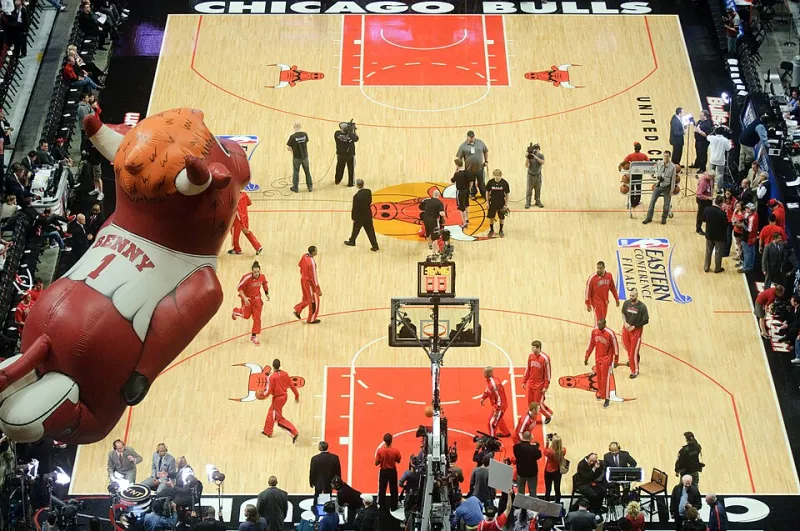
Photo: Gene Sweeney Jr., Public domain, via Wikimedia Commons
When "Too Far" Stopped Being a Real Thing
Not long ago, a player pulling up from 38 feet with eight seconds on the shot clock would've gotten benched. Coaches would've fumed. Analysts would've charted it as a "bad shot" before the ball even hit the rim. But something has shifted in the NBA over the last two seasons, and the numbers are starting to back it up.
Shots from beyond 35 feet — what most people still think of as desperation territory — are being tracked differently now. Teams are logging them, studying them, and in a handful of cases, actually drawing them up. The 40-footer has crossed a line (pun fully intended), and basketball analytics is scrambling to keep up.
The Floor Spacing Domino Effect
Here's the thing: the three-point revolution didn't just change where teams shoot from. It changed everything about how defenses are deployed. When every player on the floor is a credible threat from 25 feet, defenders have to respect that range. Push that spacing logic another 10 or 15 feet, and suddenly you've got a whole new problem for the defense.
Modern floor spacing has essentially created a coverage no-man's land at the 38-to-42 foot range. If a defender sags to protect the paint, a ball-handler can rise up from logo distance with a clean look. If the defender pushes up to contest, they've just opened a driving lane wide enough to park a truck in.
Some teams — Golden State and Dallas have been the most visible — have started using this tension intentionally. Not to actually shoot 40-footers at a high clip, but to threaten it. The shot doesn't need to go in every time. It just needs to be taken seriously by the defense. That's a new kind of leverage.
What the Shot Charts Actually Show
Let's talk numbers for a second. League-wide, shots from beyond 35 feet have increased by nearly 40 percent compared to five seasons ago. Most of those are still end-of-quarter heaves, but the subset of "voluntary" attempts — shots taken with more than three seconds on the clock — has grown noticeably.
Expected value (EV) on a 40-footer is obviously low in isolation. If a player hits 25 percent of those attempts, that's 0.75 points per possession, which sits below the league average of around 1.1 PPP. On its face, bad math.
But here's where it gets interesting: the secondary value of the threat changes the EV calculus entirely. When you factor in how often the credible long-range threat opens up higher-percentage looks elsewhere on the floor — corner threes, mid-range pull-ups, paint touches — the net offensive value of having a legitimate 40-foot shooter on the court tilts positive. It's the same logic that made corner three specialists valuable even before they were scoring machines. The threat is the weapon.
Who's Actually Making These Shots?
A small but growing group of players has started converting from logo range at a rate that's impossible to ignore. Stephen Curry remains the obvious benchmark — he's essentially been playing a different sport from that distance for years. But younger players like Tyrese Haliburton and Luka Dončić have started logging voluntary 38-plus-foot makes at a frequency that's moved them out of "fluke" territory.
Shooting coaches around the league are paying attention. Several we spoke with described a shift in how they approach long-distance training. One assistant coach from a Western Conference team (who asked not to be named) put it bluntly: "Five years ago, I'd never practice a 40-footer with a player in a real game context. Now I've got two guys where it's literally in the playbook. Not as a primary option, but it's there."
The technical requirements are steep. You need elite arc — most successful long-range shooters generate a launch angle between 45 and 52 degrees from that distance to give the ball a chance at the basket. Leg strength is critical because you're generating force from the ground up, not just the upper body. And perhaps most importantly, you need the muscle memory to replicate the motion under defensive pressure, which is an entirely different challenge than knocking one down in warmups.
How Defenses Are (Slowly) Adapting
Defensive schemes haven't fully caught up yet, and that's part of why the 40-footer is getting traction right now. Most drop coverages — designed to protect the rim against pick-and-roll ball-handlers — leave the ball-handler with a clean look from 38 feet. Teams running those coverages were comfortable with that tradeoff two years ago. Now they're less sure.
The counter-adjustment is starting to emerge. Some teams are using a "push-and-recover" technique, where the big hedges just enough to disrupt the rhythm without fully committing, then sprints back to protect the paint. It's physically demanding and requires near-perfect timing, but it's the most logical answer to the spacing problem.
Zone defenses have also seen a minor resurgence partly because they make it harder to create clean catch-and-shoot looks from deep. If you're worried about a guy going off from 40 feet, a 2-3 zone at least forces him to beat a second defender rather than shooting over air.
The Bottom Line
The 40-footer isn't going to become the NBA's bread and butter. The math still doesn't fully support it as a primary option, and most players simply don't have the consistency to make it viable. But the conversation has changed. Teams are no longer automatically charting a logo-range attempt as a bad shot. They're asking a more nuanced question: who took it, and why?
For a sport that has always pushed its own boundaries outward — literally and figuratively — the 40-foot line feels less like a ceiling and more like the next frontier. Point3.net will be watching every inch of it.