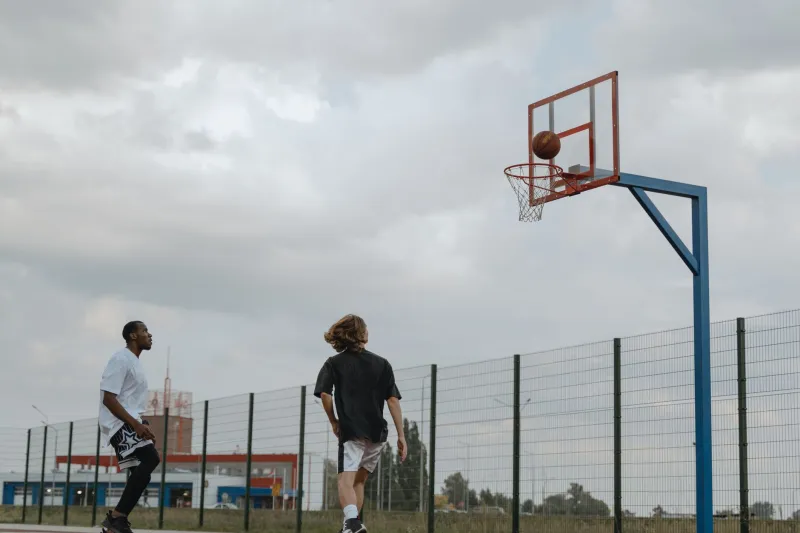
One Man, Five Defenders: The Real Price Teams Pay to Contain an Elite Shooter

There's a moment in almost every NBA broadcast where a color analyst will point to an elite shooter standing in the corner and say something like, "He doesn't even have the ball, but look at how the defense is reacting." The camera zooms out, you see a defender cheating off someone else, a help rotation that's half a step too early, a big man who's drifted six feet from his assignment — all because one guy on the perimeter might catch a pass.
That's gravity. And it costs the defending team every single possession it happens.
What's new is that we can actually measure it now. Between Second Spectrum's optical tracking, the league's own player-tracking data, and a growing wave of analytics shops crunching proximity numbers, the "gravity tax" — the hidden defensive price paid to contain a single elite shooter — is becoming one of the more quantifiable concepts in modern basketball. And what the numbers show is genuinely striking.
What Gravity Actually Looks Like in the Data
Let's start with a baseline. In a standard defensive possession, a team's five defenders are distributing their attention across five offensive players. Positioning data tells us where each defender is standing relative to their assignment, how quickly they close out, and how often they're within "contest range" — roughly four feet — when a shot goes up.
When an elite three-point shooter enters the equation, those distributions shift fast. Defenders assigned to the shooter's teammates start shading toward him. Not dramatically — we're not talking about a full double-team — but enough. Studies using proximity data from recent seasons show that defenders guarding players adjacent to elite shooters (defined here as 40-plus percent from three on high volume) average roughly 12 to 18 inches closer to the shooter's position than they do against average shooting threats. That's not a lot. But 12 inches is the difference between a contest and a clean look, and it's happening on every single possession.
The shooter doesn't have to do anything. He just has to stand there.
The Rotation Problem
Here's where it gets expensive. When a defense is perpetually tilted toward one shooter, help rotations — the choreography that keeps defenses from getting blown up in the paint — start breaking down.
Think about a drive from the wing. In a normal defensive scheme, the weak-side corner defender is the last line of protection. He's supposed to be sitting in a spot where he can either take a charge, force a tough pass, or recover to his shooter if the ball swings. But if that corner defender is already shading two steps toward an elite shooter on the opposite wing, his ability to fulfill that role shrinks considerably.
Tracking data from several playoff series over the past three seasons shows a consistent pattern: teams defending against rosters with one elite shooter (38-plus percent from deep, 6-plus attempts per game) gave up corner three-point attempts to other players at a rate roughly 22 percent higher than teams defending against rosters without that same threat. The elite shooter, in other words, was generating open looks for his teammates not by passing — just by existing.
That's the gravity tax in its purest form. You pay it in corner threes you never wanted to give up.
Putting a Number on the Damage
So how do you actually quantify this? One approach is to look at expected points per possession lost through defensive misallocation.
Here's the rough math: if a defense is giving up corner three attempts at an elevated rate because of a shooter's gravity, and corner threes convert at around 38 percent league-wide, each extra corner three attempt generated by that gravity effect costs the defense approximately 1.14 expected points. If a gravity-heavy roster generates, conservatively, four additional "gravity-assisted" corner threes per game across a season — a modest estimate — that's roughly 375 extra expected points surrendered over 82 games. Spread that across a full season and you're looking at a number that would comfortably crack the top five in point differential impact.
And that's just the corner three. It doesn't account for mid-range pull-ups off drive-and-kick actions, free throws generated when a help defender over-rotates and fouls, or layups at the rim when nobody rotates at all.
Why Box Scores Miss This Entirely
Here's the frustrating part for anyone who still lives and dies by traditional stats: none of this shows up in a box score. The elite shooter might finish a game with 14 points on 3-of-7 from three. His gravity-assisted teammates might combine for 28 points on shots they never would have gotten without him. The box score credits the shooter with 14 points and his teammates with 28 points. The actual causal relationship — the fact that his presence unlocked those 28 points — is invisible.
This is why plus/minus metrics, for all their flaws, tend to capture elite shooters more accurately than raw scoring averages. When you track what happens when a guy is on the floor versus off it, the gravity effect starts bleeding into the numbers. Teams with elite shooters don't just score more when those shooters are active — they score differently. More efficiently. From better spots. Against more compromised defenses.
The challenge is isolating how much of that improvement is directly attributable to the shooter's gravity versus, say, his passing, his off-ball movement, or simply the quality of his teammates. That's where the proximity and positioning data earns its keep. It lets analysts separate "this team is better" from "this specific player is forcing the defense to make impossible choices."
What Defenses Are Trying — and What Isn't Working
Coaches aren't blind to this. Over the past few seasons, we've seen a real evolution in how teams try to neutralize gravity without completely abandoning their defensive structure.
Zone looks — particularly 2-3 zones with a mobile high defender who can cover the arc — have made a quiet comeback partly because they reduce the individual-assignment problem. If no single defender "owns" the elite shooter, the gravity effect theoretically gets distributed across the zone rather than collapsing one specific rotation.
The problem is that elite shooters tend to be elite because they can find the soft spots in zones. Steph Curry, Klay Thompson, Buddy Hield — these guys have spent careers reading zone coverage and punishing it. You might solve the rotation problem and create a new one.
Other teams have experimented with switching schemes that put their best athlete on the elite shooter full-time — essentially dedicating a defensive ace to shadow duty for entire possessions. That helps with direct containment but creates mismatches everywhere else, which is its own kind of gravity tax paid in a different currency.
The honest answer is that there's no clean solution. The gravity tax is, in some ways, a feature of how modern basketball is designed. Space the floor with shooters, create impossible choices for the defense, exploit whichever option the defense takes away. Elite shooters sit at the center of that entire ecosystem, collecting value on every possession whether they touch the ball or not.
The Takeaway
The next time you're watching a game and the broadcast zooms out to show an elite shooter standing in the corner, doing nothing, while the defense subtly contorts itself around him — know that you're watching money change hands. The defense is paying a tax. The offense is collecting it. And the box score won't record a single cent of the transaction.
That's the hidden math of shooting gravity. And the teams that understand it best — both how to generate it and how to survive it — are the ones that tend to be playing in May.