Is Your Shooter Actually in a Slump? Here's How to Tell the Difference
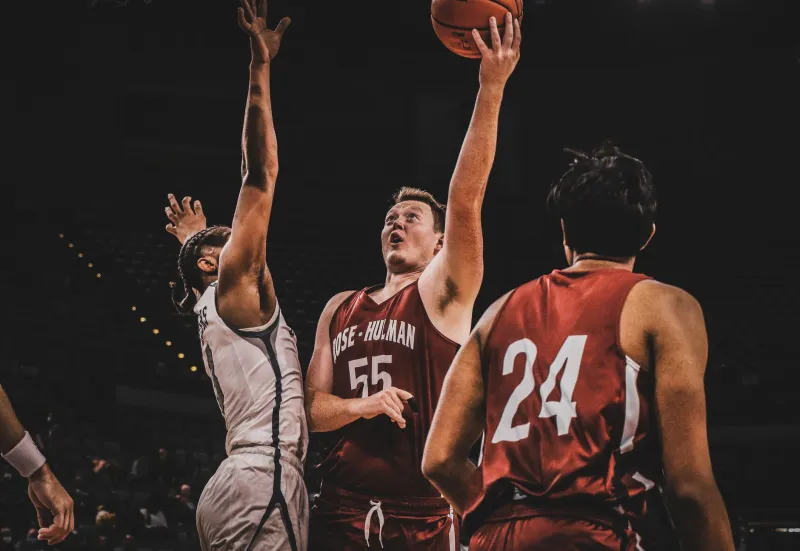
It's the moment every basketball fan dreads. Your guy — the one you've been riding all season, the shooter who's been automatic — bricks another open three. The crowd groans. The announcers start whispering about his mechanics. Your group chat goes nuclear.
But here's the thing nobody in that group chat wants to hear: there's a very good chance nothing is actually wrong.
Three-point shooting slumps are one of the most misunderstood phenomena in basketball, at every level from the NBA down to college ball. Fans see them as evidence of something broken. Coaches sometimes treat them like a crisis. But the data tells a messier, more complicated story — and understanding it might just save you from overreacting to something that was always going to fix itself.
The Variance Problem Nobody Talks About Enough
Let's start with the math, because the math is genuinely wild.
Assume a shooter hits 38% from three on the season — a respectable, above-average mark. Now run a simulation of what that shooter's game-to-game and week-to-week results would look like across a full season. What you find is that stretches of 3-for-18, 4-for-22, even 2-for-15 are not just possible — they're statistically expected multiple times per season, even if the shooter's underlying ability never changes at all.
This is variance. It's not a bug in basketball. It's a fundamental feature of any activity involving probabilistic outcomes. Three-point shooting, at its core, is a coin flip — just one where a good shooter's coin lands on heads about 38% of the time instead of 50.
Flip that coin 15 times and you'll occasionally get two heads. That's not the coin being broken. That's probability.
The problem is that our brains are spectacularly bad at processing randomness. We see a pattern — miss, miss, miss — and we construct a narrative around it. The mechanics are off. His confidence is shot. The defense figured him out. Sometimes those narratives are true. But often, we're just telling stories about noise.
So How Do You Actually Spot a Real Slump?
Okay, so variance is real and we should calm down. Got it. But that doesn't mean every cold stretch is meaningless. Genuine performance decline does happen. The trick is knowing what signals to look for instead of just watching the makes and misses pile up.
Shot quality is your first checkpoint. Not all three-point attempts are created equal. A shooter who's going cold on wide-open catch-and-shoot opportunities is in a very different situation than one who's going cold on contested pull-ups off the dribble. If the shot quality is holding steady — good spacing, clean releases, uncontested looks — and the ball just isn't going in, that's variance. If the shot quality is deteriorating, that's worth investigating.
Most college basketball analytics platforms now track catch-and-shoot percentages separately from off-the-dribble numbers. If a shooter's catch-and-shoot rate tanks while his off-the-dribble attempts stay flat, that's a sign that either his mechanics are off or he's forcing more difficult shots than usual.
Release point and shot arc are the next layer. This one is harder to track without advanced video tools, but even a casual eye can spot it over time. A shooter whose release point drops even slightly — maybe from fatigue, maybe from a minor mechanical hitch — will see his percentage fall without any change in shot selection. This is where coaching staffs earn their money. A good shooting coach can diagnose a mechanical issue in two days of film. A fan watching the box score can't see it at all.
Defensive attention is the wild card. This is one of the most underrated factors in three-point slumps, especially at the college level. When a shooter gets hot, defenses adjust. They start sending a second defender on off-ball screens. They play him tighter on the catch. They switch assignments to put their best perimeter defender on him. All of this happens before the shooter ever touches the ball, and none of it shows up cleanly in traditional stats.
The result can look like a slump when it's really just a defense doing its homework. A shooter going 4-for-16 while drawing twice the defensive attention he was getting three weeks ago might actually be performing better, in a per-opportunity sense, than his raw line suggests.
The Psychological Layer
Here's where things get genuinely complicated, because confidence is real even if it's hard to quantify.
Studies on athletic performance have consistently shown that negative psychological states — anxiety, loss of confidence, heightened self-consciousness — can measurably affect shooting mechanics. The phenomenon of "paralysis by analysis" is documented in motor skill research. A shooter who starts consciously thinking about his elbow alignment mid-release is going to shoot worse than one operating on automatic.
But here's the nuance: the psychological effect tends to show up in mechanics, not just outcomes. A shooter who's genuinely rattled will show it in release consistency, in shot arc variability, in the rhythm of his pre-shot routine. If those mechanical markers are stable and the ball still isn't going in, the problem is probably variance, not psychology.
For fans watching college basketball in particular, this matters a lot during March. Tournament pressure is real. A freshman shooter who's been excellent all season might tighten up on the big stage in ways that are legitimately concerning. A senior who's been there before? His cold stretch in the second week of March is probably just variance catching up with him at the worst possible moment.
The Practical Takeaway
Next time your favorite shooter goes ice cold, run through this checklist before you start calling for his benching:
- Are the shots still good shots? Open looks that aren't falling are variance. Bad shots that aren't falling might be something else.
- Has the defense changed? More attention equals harder shots equals lower percentage — that's not decline, that's respect.
- Does the mechanics look different? If his release looks the same as when he was hot, trust the process.
- How long has it actually been? Two weeks of cold shooting across 12 games is a small sample. Real decline shows up over months, not weeks.
The three-point line is the most volatile scoring zone in basketball. It creates the biggest swings, the longest cold stretches, and the most dramatic hot runs. That volatility is part of what makes it so compelling to watch and so endlessly fascinating to analyze.
But before you write off your shooter, make sure you're reading the right numbers. Because more often than not, the slump you're watching isn't a crisis. It's just math doing what math does — and the buckets are already on their way back.