Too Much of a Good Thing: How Stacking Elite Shooters Can Actually Help the Defense
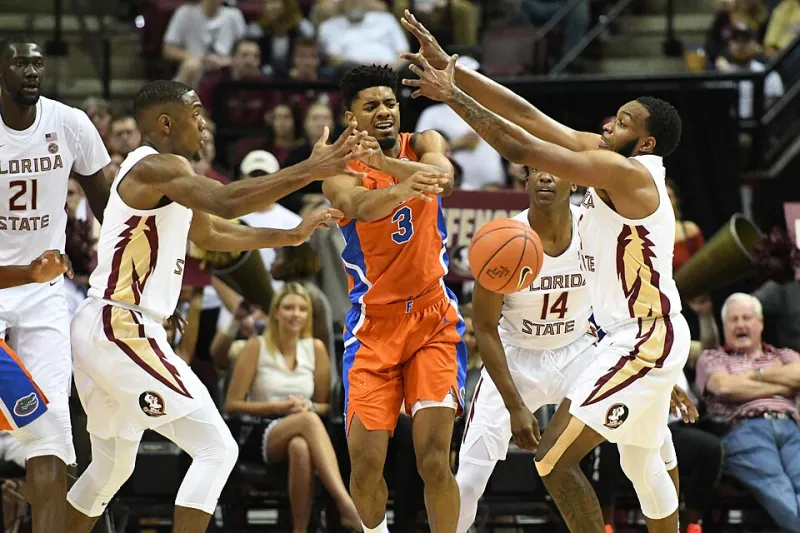
Photo: Jacob Gralton, CC BY-SA 2.0, via Wikimedia Commons
Every general manager in the NBA wants shooters. The logic is clean: spread the floor, punish help defenders, and let your playmaker operate in open space. Load up on enough three-point threats and the defense basically has to guard every inch of the arc, right?
Not exactly. And the teams that have learned this lesson the hard way have the disappointing seasons to prove it.
There's a counterintuitive phenomenon that's been quietly reshaping how smart defensive coaches approach shooter-heavy lineups. When an offense leans too heavily on spacing and perimeter shooting, it can actually become more readable — and more exploitable — than a balanced attack. Call it the gravity trap: the better your shooters, the more predictable your patterns, and the more ammunition you hand a disciplined defense.
What Gravity Actually Does (and Doesn't Do)
Shooter gravity is real. When you have a guy who's shooting 40% or better from deep, defenders can't afford to give him daylight. That attention opens lanes, creates mismatches, and gives the ball-handler room to breathe. The concept has been central to modern offensive philosophy since the league started chasing three-point efficiency in earnest.
But gravity has a ceiling. When every player on the floor is a legitimate shooting threat, something interesting happens: the defense stops having to make hard choices. There's no weak link to sag off, no big man camping in the paint to exploit. Every defender is locked in on their assignment, and the offense loses the asymmetry it was counting on.
More importantly, teams that rely heavily on spacing tend to funnel their half-court offense into predictable actions. Drive-and-kick. Drive-and-kick again. Swing it to the corner. Reset. When that's your entire playbook, a well-prepared defense doesn't need to gamble — it just needs to stay disciplined and trust its rotations.
The Pattern Problem
Here's where the data gets interesting. Teams with four or five legitimate three-point threats often see their offensive efficiency plateau or even dip compared to expectations. The reason isn't talent — it's redundancy.
When your spacing is always perfect and your shooters are always in the same spots, you're essentially running the same play over and over with different personnel. Defenses are scouting operations now. They have film rooms, tracking data, and coordinators who can identify your tendencies down to which foot your point guard pivots on. A predictable floor set is a gift.
Savvy defensive coaches have started scheming specifically around this. Rather than scrambling to contest every catch-and-shoot look, they're funneling ball-handlers into predetermined traps — knowing exactly where the kick-out pass is going before it happens. The result? Deflections, turnovers, and transition buckets going the other way.
Case Study: The Golden State Hangover
The Warriors built a dynasty on spacing and shooting. But even Golden State has hit walls when the roster became too homogenous. The 2022-23 and 2023-24 versions of that team struggled at times not because the shooting disappeared, but because the offense became one-dimensional in ways that sharp playoff defenses could scheme around.
When you can read an offense's entire decision tree in the first two seconds of a possession, you don't need elite athleticism to defend it. You need preparation and communication — two things that good coaching staffs have in abundance come postseason time.
The Nets' short-lived superteam era offers another data point. Brooklyn added shooter after shooter to support Kevin Durant and James Harden, yet the offense never reached its expected ceiling. Floor spacing was never the issue. The issue was that defenses knew exactly what was coming and could position themselves accordingly, even against elite talent.
When Predictability Becomes a Liability
The most dangerous offenses in the league aren't the ones with the most shooters — they're the ones that force defenses into impossible decisions. Think about what makes a team like the Denver Nuggets under Nikola Jokic so difficult to guard. It's not that every player is a lights-out shooter. It's that you genuinely don't know where the ball is going next.
That unpredictability is the real currency of elite offense. Spacing is a tool to create it — not a substitute for it.
When teams treat three-point shooting as a strategy rather than a weapon, they're essentially outsourcing their half-court creativity to floor geometry. And geometry, unlike a great point guard, doesn't adapt mid-game.
What Smart Teams Are Doing Differently
The franchises that have figured this out are being deliberate about mixing shooter profiles. Instead of stacking pure catch-and-shoot guys, they're pairing them with players who can create off the bounce, make decisions in the paint, or operate effectively from mid-range. The variance in skill sets keeps defenses from locking into a single read.
Coaches are also getting smarter about motion. Running shooters off screens, using ghost cuts, and incorporating more off-ball movement forces defenders to stay honest rather than camping in passing lanes waiting for the predictable kick-out.
The three-point revolution isn't over — it's just maturing. The next wave isn't about adding more shooters. It's about deploying the ones you have in ways that defenses can't map out before the play even develops.
More shooting is only an advantage if the other team doesn't know exactly what you're going to do with it.